








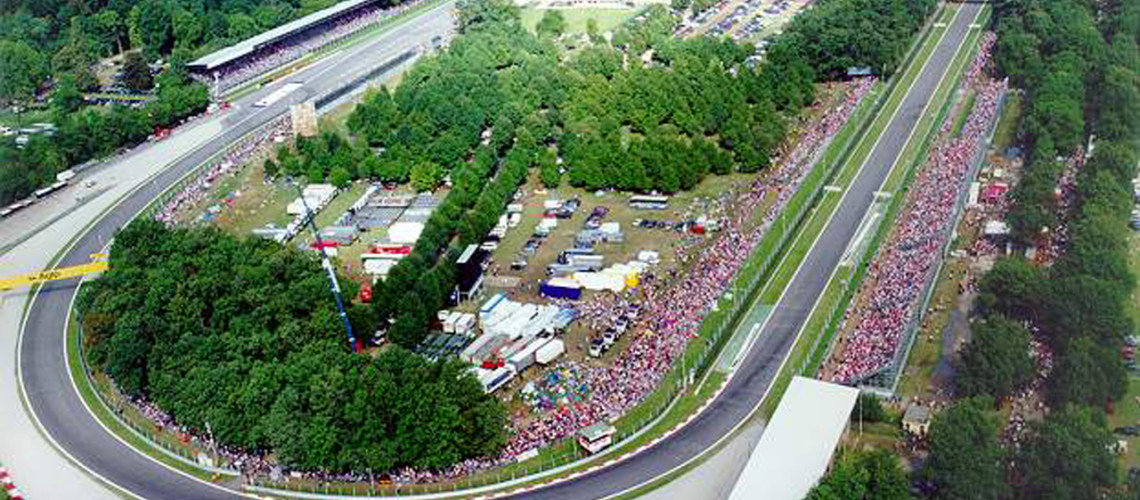
The Monza racetrack is one of the oldest racetracks in the world. It is the home of the Italian Formula 1 Grand Prix, played 78 times on this circuit.
Over the years the circuit has been overhauled several times: in 1939 a large part of the track was rebuilt, the high speed ring was abolished and a new straight was created, longer and parallel to the one above, extending the circuit up to the current 6,300 meters.
From '39 to '54 it was used as a track on which to carry out car and tire tests, its potential was not yet expressed and recognized as it is now.
Monza represents an extremely technical circuit, strong nerves and high concentration are fundamental, given the considerable speeds reached by motorcycles and cars.
Its uniqueness makes it almost magical, the forbidden dream of every speed lover.
An online booking service is active, for all those who wish to do free practice on motorbikes.
Depending on the motorcycle used (whether street or racing) there are particular precautions to be respected.

We see below the indications:
ROAD MOTORCYCLES:
- Own an insured motorcycle, greater than 250cc, equipped with silencer, license plate and tires rigorously sculpted stop.
- Be over 18 years of age.
- Be in physical possession of the license to be able to collect the entry ticket at the racetrack.
- Hand in the completed “Free road tests” form.
- Have clothing consisting of overalls, helmet, gloves and boots.
RACE BIKES:
- Own a racing motorcycle, over 250cc, silenced.
- Be 14 years of age.
- Be in possession of a valid IMF or FIM Speed / FMI Sport 2014 license
- Hand in the completed “Free road tests” form.
- Have clothing consisting of overalls, helmet, gloves and boots.

The characteristics of the track
Let's examine in detail the curves and characteristics of the track:
Curve Biassono, also called "curvone", a long curve tending to the right with a wide and extended radius. You get there in full acceleration so it is essential to have a clean and precise trajectory.
Variant of the Roggia, it brakes under the overpass up to the second gear, trying to stay as far to the right as possible so as not to lose precious speed at the entrance.
Curve Lesmo N.1, takes over in acceleration from the Roggia variant, always right curve with the peculiarity of being blind. It is essential to brake deeply in the curve to maintain speed in the central part.
Curve Lesmo No.2, yet another medium speed right curve, the imperative is to go out as hard as possible to face the long straight in the right way.
Curaglio del Serraglio, very slight bend to the left, downhill, the radius of the width is considerable.
Variant Ascari, brakes very late, as late as possible, trying to keep the speed high in the first strong braking left. After braking there is a succession of left-right-left folds that lead to the straight
opposite to the boxes. Section of the ideal circuit for overtaking, the exit speed is the key.
Parabolic curve, also here it is important to brake late, after the synthetic grass on the left at the 100-meter sign, touch the apex at the entrance and go through the final stretch in full acceleration.
The only "flaw", if you want to call it that, is the environmental impact.
At the time of construction, the initial project was discarded because it was too invasive and replaced with a more modest one, 10km long, taking advantage of existing roads.
Monza, an integral part of Italian history, over the years has become a true icon of the world of speed, world-renowned.
